
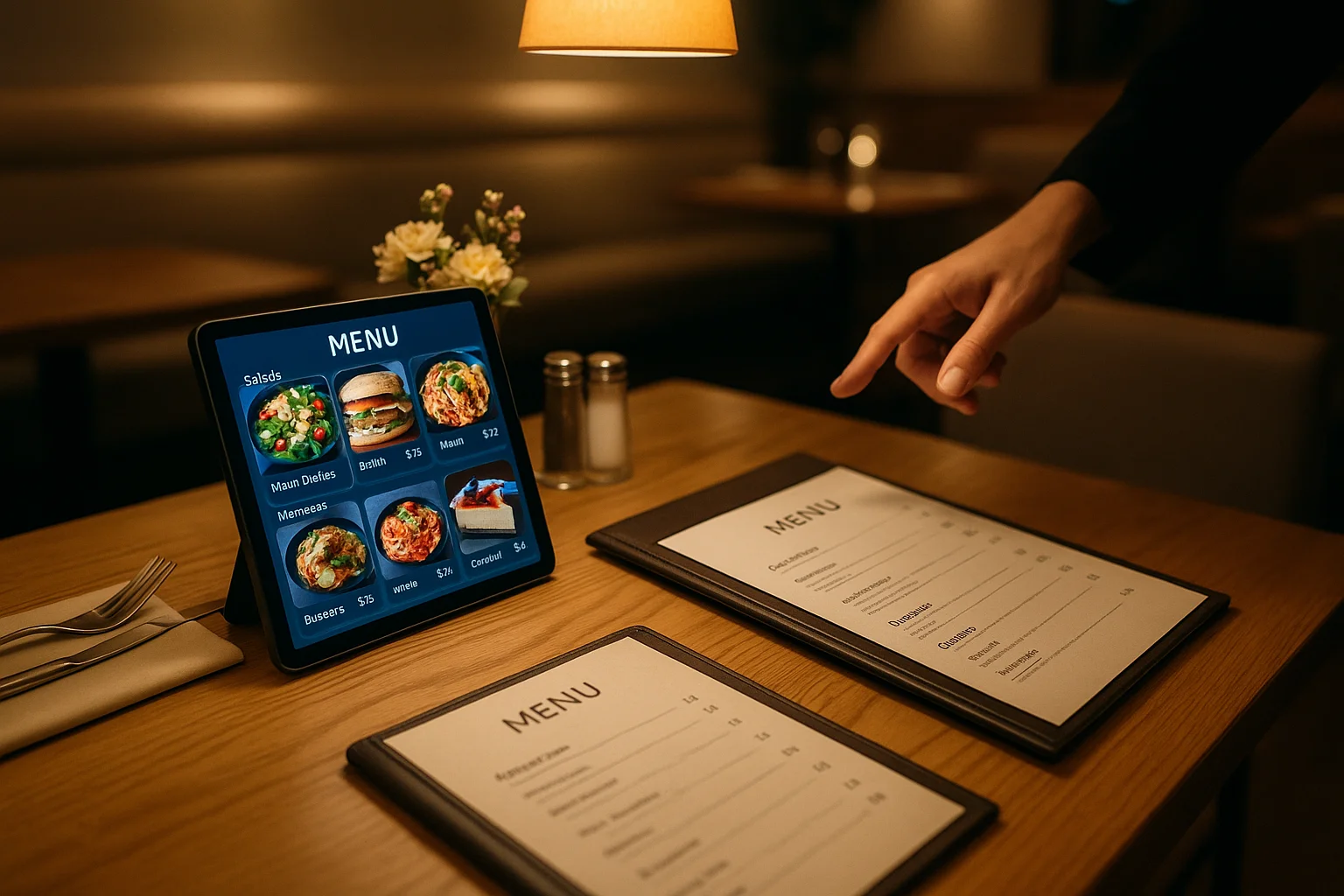
Digital menu vs traditional menu: the real advantages
The HoReCa industry in Romania is at a moment of accelerated transformation, and one of the most visible changes is happening right on the customer's table: the menu. More and more restaurant owners are discovering concrete digital menu advantages over the classic printed version — from real savings in time and money, to an improved experience for customers. But what are the real differences? And is the transition really worth it? In this article, we compare the two options honestly and completely, so you can make the right decision for your business.
What is a digital menu in 2026 and how does it work
A digital menu is an online version of the classic menu, accessible from any smartphone by scanning a QR code. The customer scans the code from the table, and within seconds sees the complete list of dishes, with photos, prices, descriptions, ingredients and allergen information — without touching a physical menu.
If you want to better understand the technology behind it, you can read our article about what a digital QR menu is and why restaurants need it in 2026. The Menivo platform, for example, allows you to create, edit and publish a complete digital menu in a few minutes, directly from your browser, without technical knowledge.
In 2026, a digital menu no longer means just a page of text on a phone. Modern platforms include advanced features such as online reservations, direct orders, customer reviews, multilingual support and integration with the restaurant's POS system.
Digital menu advantages over the traditional printed menu
The printed menu has been the industry standard for many years. It looks good when new, conveys a certain elegance and doesn't require internet. But it comes with significant disadvantages in the long run: reprinting costs for every price or product change, physical wear, difficulty displaying allergen information in accordance with current legislation, and the inability to quickly update seasonal offerings.
Here are the main advantages of the digital menu compared to the classic one:
- Instant updates, with no printing costs: You change a price or add a new dish directly from the platform, and the customer sees the change in real time, without having to wait for a new printed edition.
- Complete information about allergens and nutritional values: According to European legislation, restaurants are required to display allergens. With a digital menu, you can easily meet these obligations and keep them updated. Read more in our guide about restaurant food allergens – legal obligations in Romania.
- Professional photos for each product: A digital menu allows attractive images to be displayed for each dish, which directly influences the customer's purchasing decision.
- Reduced operational costs: You no longer pay for printing, laminating or replacement due to wear. The investment in a digital subscription is quickly recovered.
- Multilingual support: Restaurants in tourist areas can display the menu simultaneously in Romanian and English, without printing separate versions.
- Improved hygiene: Physical menus are among the most touched objects in a restaurant. A QR code completely eliminates this problem.
If you want to see a more detailed comparison between the platforms available on the market, check out the article Menivo vs. other digital menu platforms.
What useful features should a QR menu have in 2026
Not every digital menu is created equal. If you're looking for a solution for your restaurant, there are a few essential features you should check before choosing a platform.
A modern and complete QR menu should include:
- Drag-and-drop editor — for quickly reorganizing categories and products without technical help.
- Allergen and nutritional value management — mandatory according to European legislation and useful for customers with special needs. You can find out more about how to correctly add allergens to each product.
- Online reservation feature — customers can book a table directly from the menu, without calling the restaurant. This reduces the rate of lost reservations and saves staff time. Read more about table reservation and how it brings you more reservations.
- Online orders (pickup and delivery) — customers can place orders directly from the menu, with instant notification to the owner.
- Review system — collect real feedback from customers and manage it from the admin panel.
- Unique QR code generator — each restaurant receives a personalized QR code, downloadable and easy to display on tables.
- Statistics and analytics — you can see how many scans your menu has received, which products are the most viewed and how traffic evolves over time.
The Menivo platform integrates all these features into a single accessible solution. You can see how to create a digital menu for your restaurant in 10 minutes by following the simple steps in our guide.
Why the online reservation feature makes the difference
One of the most underestimated features of a modern digital menu is the possibility of online reservation. A customer who scans the QR code from a flyer, from Google Maps or from your website can book a table directly, without having to search for the restaurant's phone number and without risking not finding anyone available.
For the restaurant, the benefits are clear: reservations go directly to the admin panel, staff receive instant notifications, and confirmation or decline is done with a single click. There are no more reservations lost in WhatsApp messages or paper notes.
This feature is especially valuable during busy periods — weekends, holidays or evenings with special events — when the volume of phone calls exceeds the staff's capacity to respond efficiently.
How to transition from the printed menu to the digital one with Menivo
Switching to a digital menu doesn't have to be complicated or expensive. With Menivo, you can create a fully functional menu in a few minutes, following a simple and intuitive process:
- Register for free on menivo.io
- Add your restaurant: name, address and logo
- Create the menu categories (Appetizers, Main Courses, Desserts, etc.)
- Add products with photos, prices, descriptions and allergen information
- Generate the unique QR code from the dedicated section
- Download and display the QR code on tables, at the entrance or on promotional materials
If you prefer a detailed guide, you can follow the complete tutorial in the article creating a restaurant menu in Menivo – step-by-step guide. Also, if you want to better understand why more and more owners are making this change, read the article about why modern restaurants are giving up printed menus.
Conclusion: It's time to switch to the digital menu
Comparing the two options, the conclusion is clear: digital menu advantages far outweigh the costs and limitations of a traditional printed menu. Real-time updates, allergen information, online reservations, direct orders and usage statistics are features that give you a real competitive advantage in an increasingly digitalized market.
The traditional menu doesn't disappear completely — some fine dining restaurants may choose to keep it as an aesthetic element. But for the vast majority of restaurants, cafes, bars and terraces in Romania, a modern digital menu is the solution that saves time, reduces costs and improves the customer experience.
If you're ready to take the step, discover the best reasons why it's worth implementing a digital menu in your restaurant — or register directly on menivo.io and test the platform with no initial costs.